
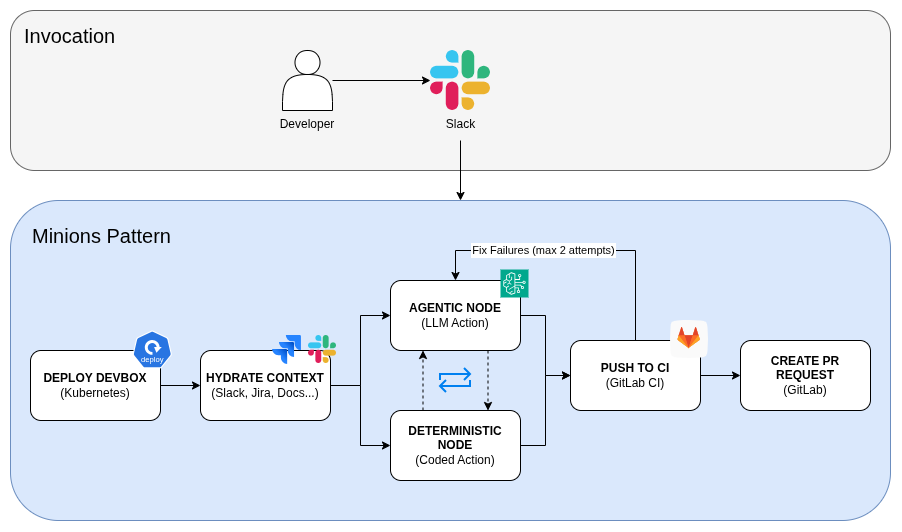
Introduction
Stripe is one of the leading technology companies, and they recently published blog posts (part 1 & part 2) on how they handle minions for one-shot end-to-end coding agents.
While most companies I speak to are not at that level yet, there are some really interesting foundational patterns they use that I consider essential building blocks for companies looking to introduce AI into their coding workflows.
Integration with existing DevOps Foundations

Stripe argues that for agents to work at scale, they must use the same tools as humans.
This is great for companies that already handle their local development environments properly. Minions run in isolated developer environments (think Cattle, not Pets) that spin up in seconds with the codebase pre-loaded.
Minions can be given “full permissions” within that box without the need for human confirmation prompts for every command.
This mirrors the pattern I recommended in 2022, if you look at this old blog post you can see most of the foundations are still valid in 2026.
MCP (Context Hydration)
A core driver of this pattern is Stripe’s use of MCP (Model Context Protocol), an open standard that allows agents to connect to various data sources.
An important concept they leverage is Context Hydration. Before a Minion even starts, Stripe “hydrates” the context by automatically pulling in linked Jira tickets, Slack threads, and documentation.
This step is key. If every company uses the same LLM, then the only way to create a competitive advantage is to give the LLM access to your own data and tooling.
Rules & Skills (Progressive Disclosure)
Context Hydration helps us prep everything. However, we need Progressive Disclosure to keep all the prep hidden until it is specifically needed. This prevents “Information Overload” (or “Token Bloat”).
This is where Rules & Skills come into play. Stripe calls these “Blueprints”. Blueprints are essentially pre-planned workflows.
They can either be:
- deterministic nodes (pre-written code e.g., “Run linter” “Push to Git”)
- agentic nodes (LLM subtask, e.g., “Implement this task,” “Fix CI failures”).
They use a standardised rule format (compatible with Cursor and Claude Code) but apply rules conditionally based on which subdirectory the agent is working in. This keeps the context window clean.
Shift-Left & Self-Healing
These concepts are nothing new in the industry, but they’re key if you want to avoid the heavy token cost. The sooner they can spot an error the better.
Stripe allows Minions a maximum of two attempts to fix failures. If it doesn’t pass after the second push, the agent stops, providing a “best effort” starting point for a human.
Summary
The Minions Pattern succeeds because Stripe didn’t just “plug in an LLM.” They integrated the LLM into a mature developer environment. By treating the agent like a junior engineer who has their own dedicated machine and a strict set of Blueprints, Stripe have scaled their approach to agentic AI.